
For over 30 years, we’ve powered Rhode Island with expert electrical services delivered with a personal touch. Discover our story and commitment to quality.
Contact Info
- List Item
For over 30 years, we’ve powered Rhode Island with expert electrical services delivered with a personal touch. Discover our story and commitment to quality.
Contact Info
Generator prices online never tell the full story. Here's what whole home generator installation actually costs in Providence County, RI — panel upgrades included.

You found a 22 kW Generac online for around $4,500. Then you got a quote for $11,000 and felt like something was off. It wasn’t. That gap between the unit price and the installed price is the thing nobody warns you about — and it catches almost every homeowner off guard.
This guide is here to close that gap. We’ll walk through what whole home generator installation actually costs in Providence County, what drives the price up or down, and why the panel upgrade question matters more than most installers will tell you upfront. By the end, you’ll have a realistic number to plan around — not a range so wide it’s useless.
The generator unit is one line item. The installation is everything else — and everything else adds up fast.
Labor to install a standby generator typically runs $3,000 to $5,000 on its own, and that’s before you factor in the automatic transfer switch ($600 to $2,500 depending on amperage), the concrete pad, the gas line connection, and the permits required by your municipality. When you add it all together, most homeowners in Providence County pay somewhere between $6,000 and $11,000 for a complete whole home generator installation.
More complex projects — larger generators, longer gas line runs, older homes that need electrical work first — can push that number significantly higher. The $5,000 quotes you see on national cost sites reflect national averages, not Providence County realities.

Generator sizing is where a lot of buyers get tripped up. The unit you need depends on what you want to power — and “whole home” means different things to different households.
A 14 kW to 20 kW generator will cover your essentials: lights, refrigerator, furnace, a few outlets, and maybe one AC zone. The units themselves run roughly $3,500 to $6,000, and installation brings the total into the $7,000 to $12,000 range for most straightforward installations.
If you want true whole-home coverage — every appliance, every outlet, central air running at full capacity — you’re looking at 24 kW or higher, and the installed cost climbs accordingly. The automatic transfer switch is non-negotiable for a standby system. This is the component that detects an outage and switches your home to generator power without you lifting a finger. It’s not optional, and it’s not cheap — budget $600 to $2,500 for the switch itself, plus the labor to install and wire it into your panel.
The size of your panel and the amperage of the switch need to match, which is one reason this isn’t a one-size-fits-all calculation. Permits are another line item that surprises people. Rhode Island requires permits for generator installations, and those permits are issued at the municipal level — meaning the process in Providence is handled differently than in Cranston or Pawtucket.
A licensed electrician who knows each jurisdiction handles this, but it’s a real cost: permits and inspections can add $100 to $2,000 to the total depending on the scope of work and the municipality. The concrete pad is a smaller number but still part of the budget. Permanent standby generators need a stable, level surface. If your yard requires site prep or the pad placement is complicated, that adds to the project cost as well.
This is the question most cost guides skip entirely — and it’s the one that matters most for a large portion of Providence County homeowners.
If your home was built before the 1970s and still has its original 100-amp electrical panel, there’s a real chance it can’t support a modern standby generator without an upgrade. A whole-home standby system typically requires 200-amp service to handle the generator connection alongside your existing electrical load. Trying to connect a generator to an undersized panel isn’t just a code issue — it’s a safety issue.
A panel upgrade from 100-amp to 200-amp service generally costs between $1,000 and $3,000, depending on the condition of the existing panel, the complexity of the work, and whether any additional wiring needs to be addressed. For older homes in Providence, Pawtucket, or Woonsocket — where pre-1950 construction is common — the panel often isn’t the only thing that needs attention.
Knob-and-tube wiring, which is still present in a meaningful number of homes throughout Providence County, can complicate a generator installation further. It affects how circuits can be connected, how loads can be distributed, and whether the overall system is safe to expand. The honest answer is that you won’t know for certain what your home needs until a licensed electrician looks at it.
What you can do is go into that conversation knowing that the panel upgrade question exists, what it costs when it’s needed, and why it matters. A contractor who doesn’t bring this up during a site visit is either not looking carefully or not telling you the full story. We pull permits, assess the full system, and tell you upfront if a panel upgrade is part of the project — before work begins, not after.
Want live answers?
Connect with a Lightning Electric expert for fast, friendly support.
Providence County leads Rhode Island in storm-related power outages. That’s not a general claim — it’s documented. In multiple major storm events, the county has accounted for the majority of statewide outages, sometimes hitting over 40,000 customers in a single event.
Nor’easters, ice storms, summer thunderstorms, high-wind events — Providence County sees them all, and the older tree canopy throughout communities like Cranston, Johnston, and North Providence means downed lines are a recurring reality. That context matters when you’re deciding whether a generator is worth it. It also matters when you’re choosing who installs it.
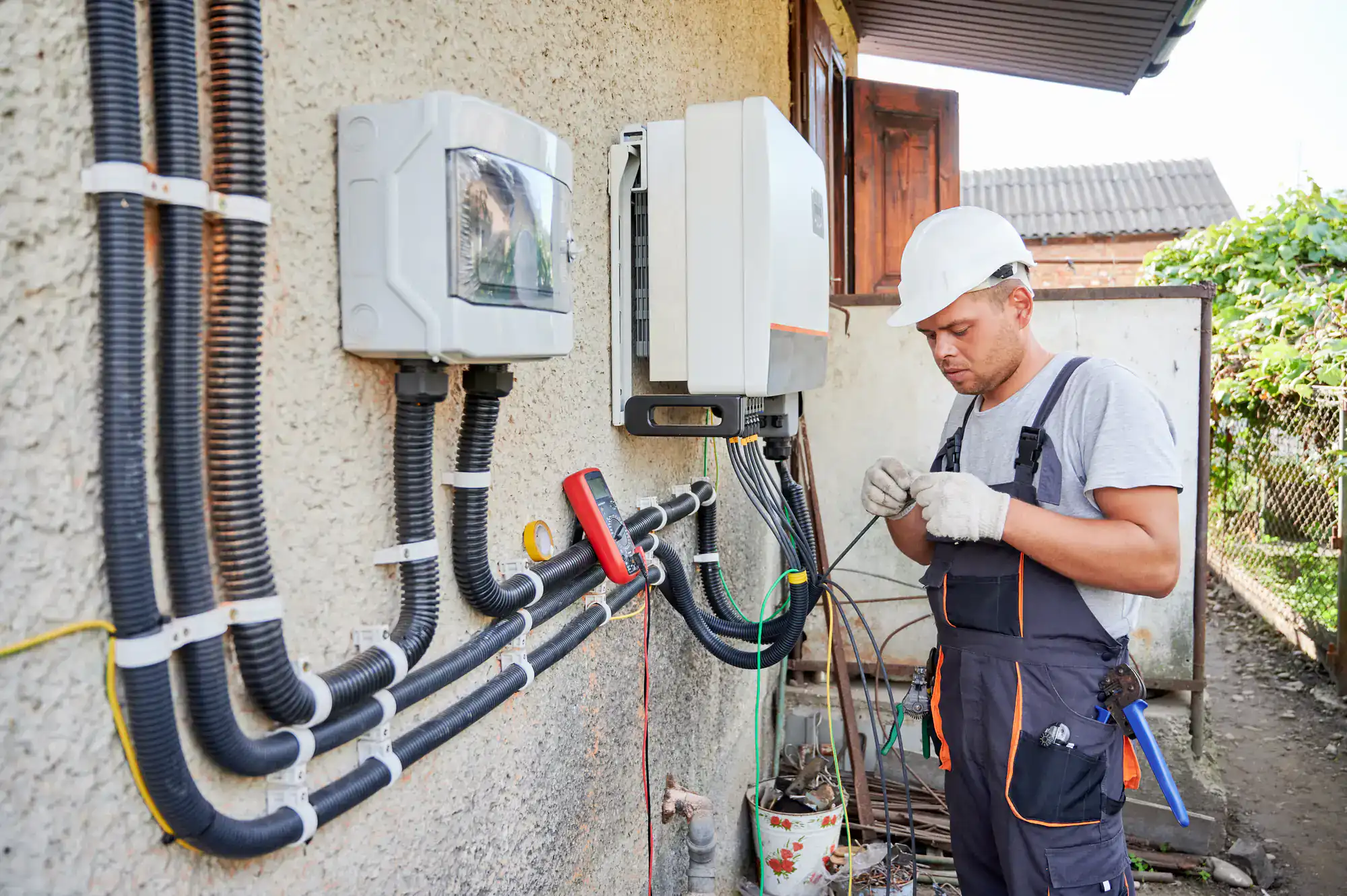
Rhode Island law requires that all electrical work be performed by persons licensed by the State’s Division of Professional Regulation of Electricians, under R.I. General Laws Chapter 5-6. Generator installation involves high-voltage electrical connections, transfer switch wiring, and integration with your home’s main panel — none of which is a DIY project, and none of which can legally be performed by an unlicensed worker in this state.
This matters more than it might seem. There’s a real difference between a licensed Master Electrician and a general handyman who’s installed a few generators. Master Electricians hold the highest tier of electrical licensing in Rhode Island. They’re the ones who can legally sign off on complex work, pull permits, and ensure the installation meets the current National Electrical Code as adopted by the state (NFPA 70).
Permits aren’t optional either. An unpermitted generator installation can create problems with your homeowner’s insurance, complicate a future home sale, and — in a worst-case scenario — leave you with no recourse if something fails. Every generator installation we complete includes permit pulling and inspection, handled by our team. The work passes the first time because our staff includes Electrical Inspector Certified professionals who understand exactly what inspectors look for.
The “who’s actually doing the work” question is one worth asking any contractor before you sign. We send only Rhode Island licensed electricians to every job — no unlicensed helpers, no subcontractors.
If your home is on the older end — and a lot of Providence County housing stock is — the budgeting conversation has a few more layers than it does for a newer build.
Start with the generator itself: $3,000 to $6,000 for a whole-home standby unit, depending on size and brand. Add $3,000 to $5,000 for installation labor on a straightforward project. Factor in the automatic transfer switch at $600 to $2,500, permits at $100 to $2,000, and the concrete pad.
If your panel needs to be upgraded to 200-amp service, add $1,000 to $3,000 to that number. If there’s knob-and-tube wiring involved, that’s a separate conversation — but it’s one worth having before the generator project begins, not during it. For a typical Providence County home that needs a mid-range generator, a new transfer switch, a panel upgrade, and standard permitting, the realistic total falls somewhere between $9,000 and $15,000.
Premium setups — larger generators, extended gas line runs, significant electrical remediation — can reach $25,000 to $30,000. Those are real numbers, and we’d rather give them to you plainly than have you discover them mid-project. The goal of every quote we provide is to show you the complete picture: what the generator costs, what the installation requires, and whether your panel needs to be part of the conversation.
If the total investment feels like a stretch right now, financing is available through Synchrony Bank. A project this size doesn’t have to be an all-at-once decision.
The wide cost ranges you find online aren’t wrong — they’re just incomplete. What you actually pay depends on your home’s existing electrical system, the size of the generator you need, your municipality’s permitting requirements, and whether any prep work needs to happen before installation begins.
In Providence County, where older homes are common and outages are frequent, that prep work is often part of the project. The most useful thing you can do right now is get a site-specific quote from a licensed electrician who will look at the full picture — panel included. That’s the only number worth planning around.
Lightning Electric has been doing this work in Rhode Island for over 30 years. We’re an authorized Generac dealer, we employ only licensed Master Electricians, and we handle permits and inspections on every applicable job. If you’re ready to stop guessing at costs and start with an honest assessment of what your home actually needs, reach out to Lightning Electric — we’re based in Riverside and serve all of Providence County.
Summary:
Article details:
Share: