
For over 30 years, we’ve powered Rhode Island with expert electrical services delivered with a personal touch. Discover our story and commitment to quality.
Contact Info
- List Item
For over 30 years, we’ve powered Rhode Island with expert electrical services delivered with a personal touch. Discover our story and commitment to quality.
Contact Info
Got a letter from your insurer about knob and tube wiring? Here's what it actually means — and what happens if you wait too long to act.
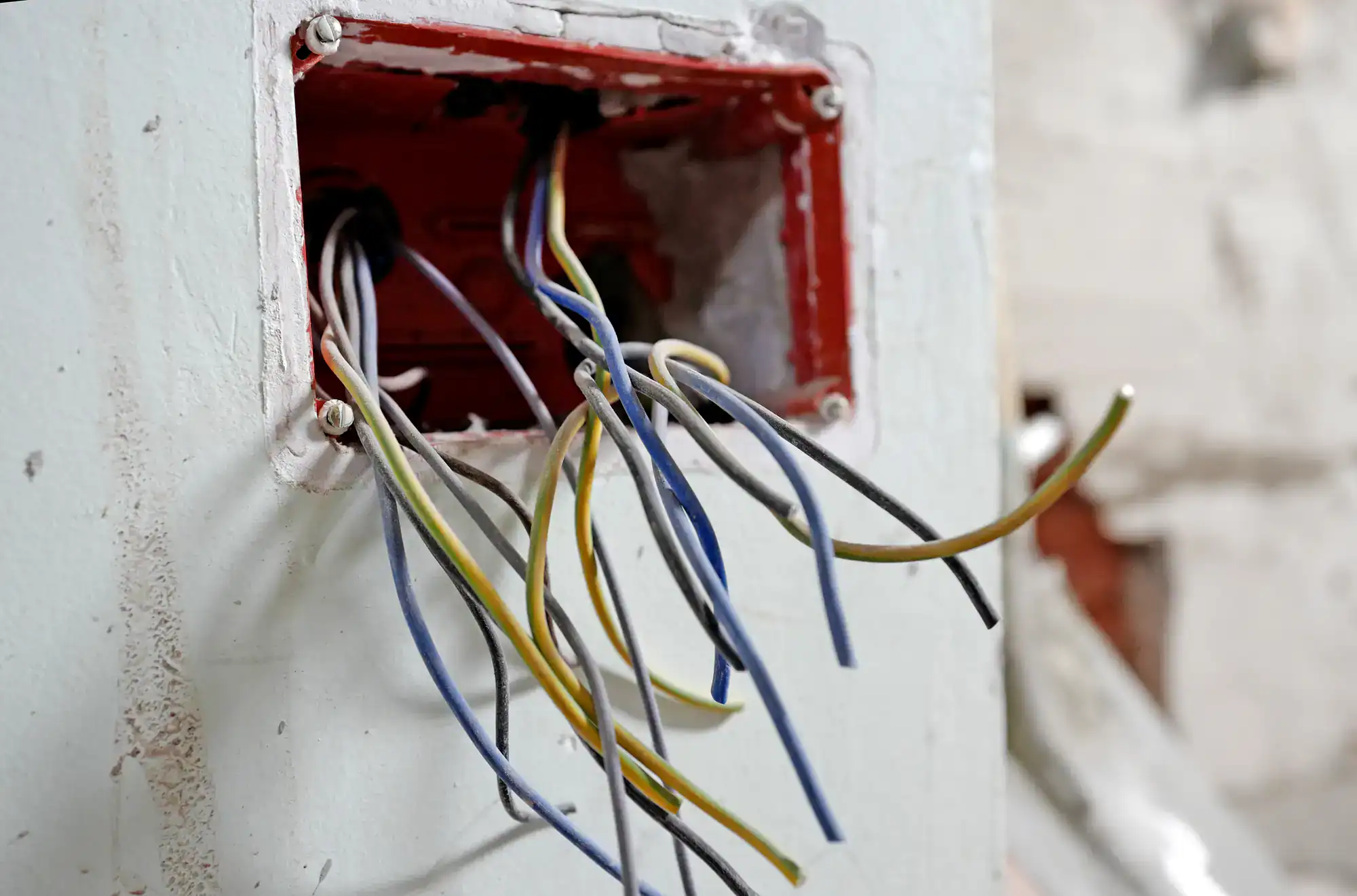
You weren’t expecting the letter. Maybe it came at renewal, maybe it followed a home inspection — but now your insurance company is telling you that your home’s wiring is a problem, and you have a window to fix it before your coverage disappears. That’s a stressful place to be, especially when you’re not entirely sure what “active knob and tube wiring” even means or why it’s suddenly such a big deal.
This is a straightforward explanation of what’s actually happening, why insurers in Rhode Island are drawing a hard line on this, and what your realistic options are. Let’s start with the distinction that drives everything.
Knob and tube wiring was the standard residential electrical system from roughly the 1880s through the 1940s. It uses separate hot and neutral conductors — no ground wire — run through porcelain knobs and tubes that were designed to keep the wires spaced away from wood framing. When it was installed correctly in its era, it did its job. The problem is that it was designed for a world that no longer exists.
The specific term “concealed knob and tube wiring” refers to the wiring that runs inside your walls and ceiling cavities — not the exposed runs you might see in an unfinished basement. Concealed K&T is what insurers focus on because it’s harder to inspect, harder to verify, and more likely to have been modified over the decades by previous owners, handymen, or unlicensed contractors who had no idea what they were working with.
When an insurer flags your home, they’re usually responding to a home inspection report or a routine underwriting review. What they want to know is whether that wiring is still active — meaning still energized and carrying current to outlets, fixtures, or circuits. That single question determines almost everything that follows.

This is the part most homeowners don’t realize, and it’s worth slowing down on. Not all knob and tube wiring is treated the same by insurers. The distinction that actually drives underwriting decisions is whether the wiring is active or inactive.
Active knob and tube wiring is still energized — it’s still connected to your electrical panel and still delivering power to parts of your home. Inactive wiring has been properly de-energized and abandoned in place, with new wiring installed to serve those circuits. Visually, the two can look identical. You cannot tell by looking at an outlet or a ceiling fixture whether the circuit feeding it is running through 100-year-old cloth-wrapped conductors or modern Romex cable. That determination requires a licensed electrician to trace the circuits.
Old knob and tube wiring that is truly inactive is a different risk profile than active wiring. Some insurers will accept it; others won’t. But active K&T — wiring that is still live, still carrying current, still subject to the full range of failure modes that come with a century of thermal cycling, degraded insulation, and accumulated modifications — is the specific condition that triggers non-renewal and cancellation notices in Providence County, RI.
The reason comes down to a few compounding issues. The original cloth and rubber insulation breaks down over time, becoming brittle and prone to cracking. The system was designed to carry approximately 10 amps; modern residential circuits routinely carry 20 to 30. And because K&T has been in place long enough for multiple owners to have touched it, there’s a high probability that somewhere in those walls, someone made a splice, added a circuit, or extended a run in a way that created a failure point that no one can see.
Insurers aren’t being arbitrary. They’re responding to a documented pattern of risk in older homes — and Providence County has more older homes than almost anywhere else in the country.
There’s a specific scenario that comes up regularly in Providence County homes, and it tends to catch homeowners completely off guard. If you’ve added blown-in insulation, batt insulation, or spray foam to your attic in the last few decades — which is a completely reasonable thing to do in a Rhode Island winter — and your home was built before 1940, there’s a real chance you’ve buried active knob and tube wiring under that insulation.
This matters because knob and tube wiring was engineered to dissipate heat into free air. The conductors run exposed, spaced away from framing, specifically so that the heat generated by electrical resistance can escape. When you cover those conductors with insulation, you trap that heat. The insulation that was supposed to make your home more efficient becomes a thermal blanket around wiring that was never designed to operate that way.
The National Electrical Code addressed this directly — NEC Section 394.12 prohibits knob and tube wiring from being installed in “hollow spaces of walls, ceilings and attics where such spaces are insulated by loose, rolled or foamed-in-place insulating material that envelops the conductors.” Rhode Island’s electrical code references the NEC, and the Rhode Island Building Code Commission has published an official interpretation specifically on this article. In plain terms: if your active K&T is buried under insulation, you don’t just have an insurance problem — you have a code violation.
For homeowners in neighborhoods like the Blackstone district, Federal Hill, Elmwood, or the West End, this combination is more common than most people expect. Over 55% of Providence’s housing stock was built before 1939, and a significant portion of those homes have had energy efficiency upgrades layered on top of original electrical systems over the years. If your home falls into this category, the urgency of your insurer’s letter is compounded — you’re dealing with two separate compliance issues at once.
Want live answers?
Connect with a Lightning Electric expert for fast, friendly support.
The process typically starts with a letter. Your insurer either received a home inspection report flagging active K&T, conducted their own underwriting review, or was notified during a policy renewal cycle. The letter will usually give you a window — commonly 30 to 90 days — to remediate the issue or face non-renewal or cancellation.
That timeline is real, and the consequences of missing it extend further than most homeowners realize. It’s not just about finding new coverage. If your policy is canceled and you carry a mortgage, your lender will be notified. Lenders require continuous hazard insurance as a condition of the loan. If coverage lapses, the lender can force-place insurance on the property — at rates that are dramatically higher than standard coverage — or, in serious cases, call the loan. The equity you’ve built in a Providence County home that has appreciated significantly over the last decade is directly at risk.

The goal of remediation is straightforward: convert active knob and tube circuits to modern, grounded wiring, document the work with permits and a final inspection, and provide your insurer with proof that the work was completed by a licensed electrician.
That last part matters more than people expect. When you submit documentation to your insurer after rewiring, they’re going to want to know that a licensed Master Electrician performed the work, that permits were pulled, and that the job passed a final inspection by the Authority Having Jurisdiction. A handshake agreement with a guy who “does electrical work” doesn’t satisfy that standard. The paper trail is what closes the loop with your insurer — and without it, you’ve spent money on a project that doesn’t actually resolve your coverage problem.
The part that stops a lot of Providence County homeowners from acting is the fear of what the rewiring process will do to their home. In a Federal Hill triple-decker or a College Hill Victorian with original horsehair plaster, crown molding, and a century of architectural character, the idea of opening up walls to run new wire is genuinely alarming. We get that. It’s one of the main reasons people put this off.
We use camera technology to locate wiring runs and junction boxes before we make a single cut. Once we know where everything is, we can route new wiring and install new grounded circuits through existing outlet openings — which means most projects involve zero to minimal wall damage. We’re not tearing your house apart. We’re working within it. For homeowners in Providence County’s historic neighborhoods, that’s not a minor detail. It’s often the reason they’re able to move forward at all.
Every applicable job we complete includes permits pulled and a final inspection passed. You’ll have the documentation your insurer needs. We also carry a Certificate of Insurance, available on request, which some insurers ask to see before accepting the remediation paperwork.
A few misconceptions come up repeatedly in conversations with homeowners who are navigating this situation, and they’re worth addressing directly because acting on the wrong information can cost you time you don’t have.
The first is the belief that knob and tube wiring is “grandfathered in” and therefore acceptable to an insurer. Rhode Island’s modified electrical code does allow for repair and maintenance of K&T in historic structures under specific conditions — but that is a code provision, not an insurance provision. Insurers make underwriting decisions independently of what local code allows. A code official telling you the wiring is grandfathered does not bind your insurance company. These are two separate conversations governed by two separate sets of rules.
The second misconception is that simply disconnecting the wiring — cutting it loose from the panel without replacing the circuits — satisfies the insurer’s requirement. For some insurers, properly de-energized and abandoned K&T is acceptable, provided you have documentation proving it was done correctly by a licensed electrician. For others, it’s not enough. The key in either case is the documentation. Without a permit and a final inspection, you have no proof of what was done, and your insurer has no basis to reinstate standard coverage.
The third, and perhaps most consequential, is the idea that non-disclosure is a viable option. If you don’t tell your insurer about the K&T and a fire or electrical incident occurs, your claim will almost certainly be investigated. If the investigation finds that active K&T was a contributing factor and you knew about it, the claim can be denied. The policy can be voided retroactively. The financial exposure from a denied claim in a Providence County home — where real estate values have risen sharply over the last decade — is far greater than the cost of remediation.
If you’re in a situation where the deadline feels impossible because of cost, financing through Synchrony Bank is available. The ability to start the project now and pay over time removes the most common reason people miss their window.
If you’ve received a letter from your insurer, the most important thing you can do right now is get a licensed electrician to trace your circuits and determine exactly what’s active and what isn’t. That assessment gives you an accurate picture of the scope of work — and it gives your insurer something concrete to respond to.
Providence County has one of the oldest housing stocks in the country. The majority of homes here were built before the mid-20th century, which means active knob and tube wiring is genuinely common — not a rare edge case. If your home was built before 1940 and hasn’t been fully rewired, there’s a real chance your insurer’s concern is legitimate and worth addressing on its own merits, independent of any deadline.
Lightning Electric has been doing this work in Rhode Island for over 30 years. We work in historic homes, triple-deckers, pre-war Victorians, and everything in between. If you’re facing an insurance deadline or just trying to understand what you’re dealing with, we’re available evenings and weekends for exactly this kind of situation. Reach out and we’ll give you a straight answer.
Summary:


Article details:
Share: