

For over 30 years, we’ve powered Rhode Island with expert electrical services delivered with a personal touch. Discover our story and commitment to quality.
Contact Info
- List Item
For over 30 years, we’ve powered Rhode Island with expert electrical services delivered with a personal touch. Discover our story and commitment to quality.
Contact Info
If your Rhode Island home has knob and tube wiring, here is what you need to know, spanning from insurance deadlines to protecting your plaster walls.
You probably did not go looking for this information. More likely, a home inspector flagged it during a sale, your insurance company sent a letter, or an electrician mentioned it while doing something else entirely. Now you are trying to figure out what knob and tube wiring means for your home, along with finding out if the situation is as serious as everyone is making it sound.
The short answer: it depends. The longer answer is what this guide is for. We have been working in Rhode Island homes for over 30 years, and we have seen every variation of this situation. Here is what you need to know.
Knob and tube wiring was the standard electrical system in American homes from roughly the 1880s through the 1940s. It gets its name from the ceramic knobs that held the wires in place along joists and studs, and the ceramic tubes that protected the wires where they passed through wood. At the time, it was a perfectly reasonable system, designed for a world of a few light bulbs and maybe a radio.
Rhode Island has one of the oldest housing stocks in the country. A significant portion of homes in Providence, Pawtucket, Woonsocket, Cranston, and coastal communities like Bristol and Newport were built during that exact era. If your home was built before 1950, there is a real chance some version of knob and tube wiring is still in your walls.

The honest answer is that undisturbed, uninsulated, unmodified knob and tube wiring is not inherently dangerous in the way people sometimes describe it. It is old and limited, but it does not spontaneously fail simply because it is present.
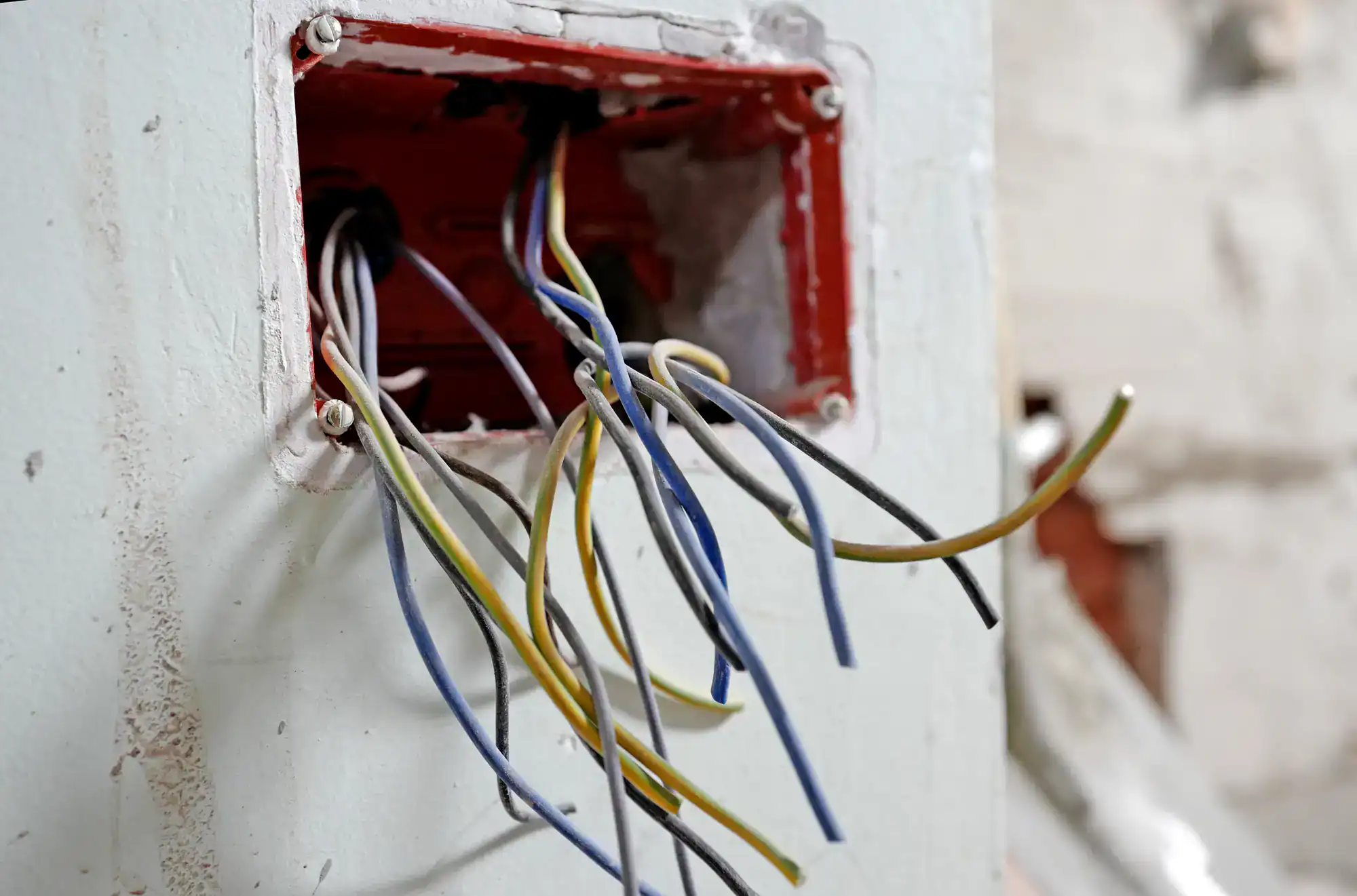
The danger comes from what happens to it over time. Decades of amateur modifications, such as a previous owner adding a circuit here or splicing a wire there, can leave the system in genuinely compromised condition. The rubber insulation that coats knob and tube wiring degrades over time, sometimes leaving bare wire exposed inside your walls.
The system was specifically designed to dissipate heat into open air. The moment someone adds attic insulation around active knob and tube wiring, the risk profile changes dramatically. This is one of the most common ways we see the system become a hazard in Rhode Island homes.
There is also the load problem. Knob and tube wiring was designed for a fraction of the electrical demand a modern household puts on a system. Your refrigerator, HVAC, home office, EV charger, and flat-screen television are all drawing power through wiring that was never built to handle it. The system does not fail dramatically; instead, it fails slowly and silently inside your walls.
One more detail worth knowing: knob and tube wiring has no grounding conductor. Modern wiring runs three conductors comprising a hot wire, a neutral, and a ground. Knob and tube runs only two. That means it cannot support GFCI or AFCI protection devices, which are now code-required in kitchens, bathrooms, and bedrooms under Rhode Island’s current electrical code. That gap in protection is a real safety limitation.
For many Rhode Island homeowners, the insurance angle is what makes this urgent. Insurers have become increasingly aggressive about knob and tube wiring over the past several years. What used to be a note on a policy has become, in many cases, an ultimatum.
Here is what that typically looks like: your insurer audits your policy, often triggered by a home sale, a refinancing, or a routine renewal, and discovers the wiring. They then give you a window, sometimes as short as 30 days, to address it or face cancellation. If they cancel, they are required to notify your mortgage lender. That is not just an insurance problem; it is a mortgage problem.
We see this regularly in Providence’s older neighborhoods, the triple-deckers of Olneyville and Federal Hill, and the historic homes of College Hill and Fox Point. The 30-day clock is real, and it creates urgency that is different from a general safety concern. You are not just thinking about the long-term risk anymore. You are thinking about your closing date, your lender, and your coverage.
Some homeowners assume that having an electrician inspect and certify the wiring as safe will satisfy their insurer. Many insurers no longer accept this. They want replacement documentation, rather than a safety letter. If you are in this situation, make sure you understand what your insurer requires before you start any work.
Want live answers?
Connect with a Lightning Electric expert for fast, friendly support.
This is the part most electricians gloss over, and it is where many Rhode Island homeowners get a rude surprise. Traditional knob and tube removal requires opening walls and ceilings to access and pull the old wiring. In a home with modern drywall, that is a significant inconvenience. In a home with original horsehair plaster, which describes the majority of pre-war homes in Rhode Island, it is a much bigger problem.
Horsehair plaster is not drywall. It cannot be patched the same way, it cannot be matched easily, and in many cases it simply cannot be restored once it is cut. For homeowners in historic neighborhoods across the state, that is not just a cosmetic issue; it is a fundamental part of why they bought the house.

This is the question we get more than almost any other, and the answer is yes. We use a camera-based system that is inserted through your existing outlets to locate and map the wiring from inside the wall cavity. That lets us remove or deactivate the knob and tube wiring without cutting into your plaster. Your walls stay intact. Your horsehair plaster stays intact. The historic character of your home stays intact.
We are the only electrician in the Rhode Island market using this technology. The standard approach most electricians use is to open the wall, do the work, and leave the patching and repainting to you. That can add significant cost beyond the electrical work itself, as drywall repair, plaster work, and repainting an interior can easily run into the thousands of dollars on top of what you are already spending.
For homeowners in places like Bristol, Newport, Barrington, or the historic neighborhoods of Providence, where the original interior finishes are part of the home’s value and character, this distinction matters enormously. We have heard from homeowners who had quotes from other electricians and walked away, not because of the electrical cost, but because they could not stomach what the traditional method would do to their walls.
It is also worth clarifying what removal entails. Visible knob and tube wiring, such as the kind you can see in an unfinished basement or attic, does need to be physically removed. However, wiring that is concealed inside finished walls does not always need to be pulled out entirely. In many cases, it can be properly deactivated as part of a code-compliant rewiring project. The specifics depend on your home, your local jurisdiction, and what your insurer requires.
A legitimate knob and tube removal job is more involved than pulling old wire and calling it done. It starts with a thorough assessment to map which circuits are active, which have been modified, and what condition the insulation is in. From there, the work involves pulling the necessary permits, deactivating and removing accessible wiring, fishing new grounded cable through the walls, installing updated outlets and switches, and passing a final inspection with the local building authority.
That final inspection step matters more than most homeowners realize. The permit and inspection process is what gives you, and your insurer, documented proof that the work was done to code. Without it, you may complete a significant project and still find your insurer unwilling to update your policy. Any electrician who suggests skipping the permit process is not doing you a favor.
Depending on the age and condition of your panel, a knob and tube removal project may also involve a panel upgrade. The original panels in many Rhode Island homes simply cannot support the circuits that modern wiring requires. A qualified electrician will identify this during the assessment phase, meaning it should not come as a surprise mid-project if the initial evaluation is done properly.
We offer financing through Synchrony Bank for projects like this because we understand that a whole-home rewiring project is a significant expense. The goal is to make it possible to address an urgent safety or insurance issue without having to delay because the timing is not perfect financially. Every job is priced individually based on the specific scope of your home, and we provide a clear written estimate before any work begins.
Our team holds Master Electrician credentials, representing the highest level of individual licensing in Rhode Island, and we belong to the IAEI Roger Williams Chapter, which is the Rhode Island electrical inspectors’ professional body. That means we know the local code, we know the inspectors, and we know what passing inspection in this state requires.
If there is one thing to take away from this guide, it is that not all knob and tube removal is the same. In Rhode Island, where so many homes have original plaster walls, complex wiring histories, and insurance timelines attached, the details truly do matter.
Ask any electrician you are considering if they pull permits, what their specific method is for accessing wiring in finished walls, and what documentation they will provide when the job is complete. The answers will tell you a lot.
If you are dealing with an insurance deadline or a home sale, or if you have simply decided it is time to address the wiring in your older Rhode Island home, Lightning Electric is ready to take a look. We have been doing this work across the state for over 30 years, and we would be glad to walk you through what your home needs.
Summary:

Article details:
Share: