

For over 30 years, we’ve powered Rhode Island with expert electrical services delivered with a personal touch. Discover our story and commitment to quality.
Contact Info
- List Item
For over 30 years, we’ve powered Rhode Island with expert electrical services delivered with a personal touch. Discover our story and commitment to quality.
Contact Info
Your home inspector flagged it. Your insurance company is asking questions. Here's what knob and tube wiring actually means for your home — and what happens if you ignore it.
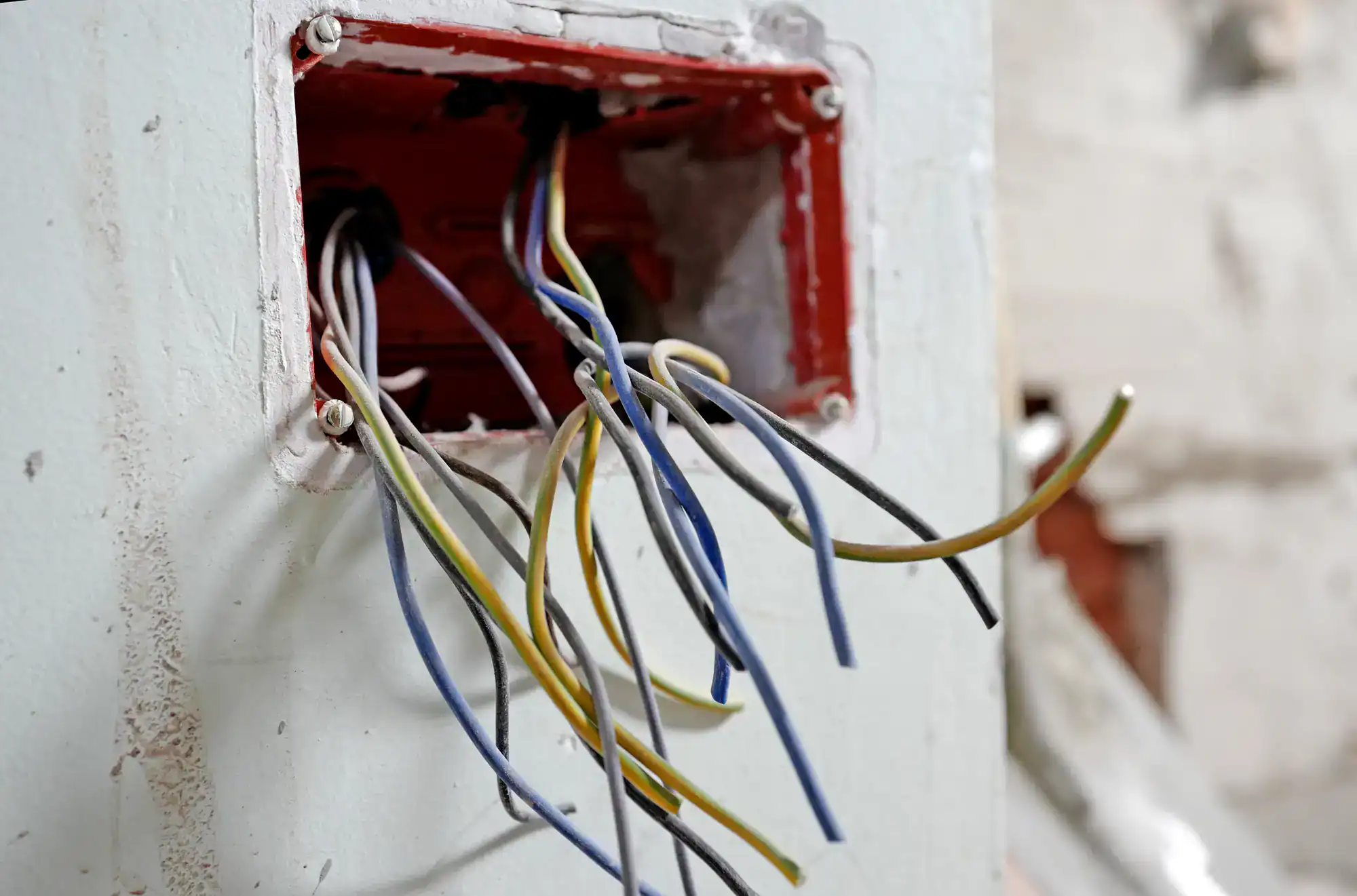
You probably didn’t go looking for information about knob and tube wiring. More likely, a home inspector flagged it in a report, your insurance company sent a letter, or someone mentioned it during a renovation conversation and now you’re trying to figure out how serious this actually is.
Here’s the honest answer: it depends. Not on the wiring itself, but on what’s happened to it since it was installed — and in most Providence County homes, that’s where things get complicated. We’ll walk you through what the real risks are, what’s often missed, and what you should do next.
Knob and tube wiring was designed to breathe. The system works by running individual wires through open air, suspended on ceramic knobs, and through ceramic tubes where they pass through wood framing. That airflow was intentional — it allowed the wires to shed heat as current ran through them.
The moment you add insulation around those wires, that design stops working. Heat has nowhere to go. It builds up around the conductor, and over time, that’s exactly the kind of condition that leads to a fire inside a wall where no one can see it.

This is the part that catches a lot of Providence County homeowners off guard. Rhode Island has some of the oldest housing stock in the country — the median owner-occupied home in the state is 59 years old, and in Providence specifically, the median construction year is 1938. Nearly 70% of Providence’s housing supply was built before 1959. That means there are tens of thousands of homes throughout Providence County where knob and tube wiring has been sitting inside walls for the better part of a century.
Over those decades, things happen. A previous owner adds blown-in insulation to the attic to cut heating costs. A contractor installs spray foam in the walls during an energy efficiency upgrade. Nobody checks whether there’s active wiring back there first, because nobody knew to ask. The wiring is now buried, surrounded by insulation, and generating heat with nowhere to escape.
When knob and tube wiring is concealed, you can’t inspect it visually. You can’t tell if the cloth insulation around the wire has cracked or deteriorated. You can’t see whether a junction was made improperly somewhere behind the plaster. And you definitely can’t tell whether it’s still carrying current.
Rhode Island’s RISE energy efficiency program has created an interesting collision in older homes. Homeowners trying to lower their energy bills — which makes complete sense given that Rhode Island electricity costs 29 cents per kilowatt-hour, about 46% above the national average — are pursuing insulation upgrades that can inadvertently create fire conditions if active knob and tube wiring is still present. A licensed electrician needs to assess the wiring before that insulation work goes in, not after.
The danger isn’t theoretical. The National Fire Protection Association reports that electrical failures cause approximately 34,000 home fires per year in the United States, resulting in more than 400 deaths and over $1.3 billion in property damage. Old, modified, and improperly insulated wiring is a documented contributor to those numbers.
Here’s something most pages about knob and tube wiring don’t cover, and it’s one of the more quietly dangerous situations we encounter in older homes.
Knob and tube circuits were designed to carry 10 to 15 amps. That was appropriate for the electrical loads of the 1920s and 1930s — a few lights, maybe a refrigerator. Modern circuits are built for 20 to 30 amps, and modern appliances — air conditioners, space heaters, hair dryers, microwaves — routinely draw more current than old knob and tube circuits were ever meant to handle.
When those circuits get overloaded, the fuse blows. That’s the system working correctly. The fuse is the protection. But somewhere along the line in a lot of these older homes, a previous owner or a handyman got tired of replacing fuses and swapped in a larger one — a 20-amp or 30-amp fuse on a circuit that was only designed for 15. The fuse stops blowing. Problem solved, right?
Not even close. What actually happened is that the only safety mechanism protecting that circuit was just removed. Now the wiring can overheat significantly before anything trips. The circuit keeps running. The walls stay quiet. And the wiring inside them can reach temperatures that degrade insulation, char wood, and eventually ignite — all without a single warning sign in the living room.
This is the kind of modification that’s almost impossible to detect without a proper inspection. The fuse box might look fine from the outside. The outlets work. Nothing seems wrong. But behind the walls, the circuit has been running without real protection for years, possibly decades. In homes throughout Providence County’s older neighborhoods — College Hill, Federal Hill, Elmwood, the mill-era blocks of Pawtucket — this is not a rare scenario. It’s a common one.
Want live answers?
Connect with a Lightning Electric expert for fast, friendly support.
One of the most important things to understand about knob and tube wiring is that not all of it is dangerous in the same way — because not all of it is still live.
Many older homes have a mix of active and inactive knob and tube wiring. Active wiring is still connected to the panel and carrying current. Inactive wiring has been disconnected at some point, either during a partial rewire or when a new circuit was run to replace it. The inactive runs are still in the walls, but they’re not doing anything. They’re not a fire risk in the same way.
The problem is that you can’t tell the difference by looking at it.

This is one of the most common questions we hear from homeowners in Providence County, and it’s a fair one. The honest answer is that a visual inspection alone usually can’t give you a definitive answer. The wiring may look identical whether it’s live or disconnected. Cloth insulation, porcelain knobs, two-prong outlets at the end of a run — none of those things tell you whether current is flowing.
A licensed electrician can use a voltage detector or other testing equipment to determine whether specific runs are still energized. But even that has limits when wiring is concealed behind plaster or buried under insulation added during a renovation. What looks like a dead circuit from the panel might still be connected somewhere further down the line through a junction that was never properly documented.
This is exactly why we use a specialized camera system that no other electrician in the area has. It inserts through your existing outlets and lets us see inside your walls in real time — locating the wiring, identifying junction boxes, spotting any damage, and figuring out what’s active and what isn’t. The result is a clear picture of what’s actually happening inside your home, without opening a single wall. For homeowners in neighborhoods like College Hill or the Wayland Square area where preserving original horsehair plaster is a genuine priority, that matters enormously. Nobody wants to find out the wiring is fine after a contractor has already torn apart a 100-year-old ceiling to look.
The distinction between active and inactive wiring also determines the scope of the work. If a portion of your home has already been rewired and the old knob and tube runs are genuinely disconnected, the job is different than if the entire original system is still live. Getting that assessment right before any work starts is how you avoid paying for more than you need — and avoid leaving something dangerous behind because it was assumed to be inactive when it wasn’t.
The insurance angle is often what pushes homeowners to finally act, and it’s worth understanding clearly.
Many national insurance carriers have become increasingly reluctant to write policies on homes with active knob and tube wiring. Some won’t write new policies at all. Others will write a policy but only on an HO-8 basis — that’s an actual cash value policy rather than a replacement cost policy, which means if your home suffers a fire, the insurance pays out the depreciated value of what was lost, not what it would cost to rebuild or replace it. In a home with original woodwork, plaster walls, and historic architectural details, that gap can be significant.
Existing policyholders aren’t always safe either. Insurance companies sometimes conduct inspections — during a refinance, a policy renewal, or after a claim — and when active knob and tube wiring is discovered, non-renewal notices follow. Homeowners have reported receiving letters giving them 30 days to provide a remediation plan or face cancellation. That’s a hard deadline with real consequences.
Industry sources indicate that homes with active knob and tube wiring can face premiums 50% to 100% higher than comparable homes with updated wiring. For a homeowner already dealing with Rhode Island’s above-average energy costs, that’s a meaningful additional financial burden.
The good news is that this is a solvable problem. Removal and replacement of active knob and tube wiring, done properly by a licensed electrician who pulls permits and passes inspections, resolves the insurance issue. The key phrase there is “done properly” — unpermitted electrical work doesn’t just fail to satisfy insurance requirements, it can create new liability when you go to sell the home. Every job we do includes pulling the appropriate permits and seeing the inspection through to completion, because that’s what actually protects you.
For homeowners who are concerned about cost, financing is available through Synchrony Bank. The goal is to make sure cost doesn’t become the reason someone puts this off.
If you’ve made it this far, you probably already know the wiring in your home needs a closer look. The most important first step is finding out whether your knob and tube wiring is active, where it runs, and whether it’s been modified or insulated over in a way that creates risk. That’s not something you can determine from a home inspection report or a conversation with a neighbor — it takes a proper assessment by someone who knows what they’re looking at.
Providence County has some of the oldest housing stock in the country. That’s part of what makes this region’s homes so distinctive. It’s also why knob and tube wiring is such a common reality here, and why the specific dangers — insulation contact, oversized fuses, concealed modifications — deserve a straight answer rather than a generic checklist.
If you have questions about what’s in your walls, we’re here to help. Lightning Electric serves all of Providence County and the surrounding area, and we’ve been doing this work in Rhode Island’s older homes for over 30 years.
Summary:


Share: