

For over 30 years, we’ve powered Rhode Island with expert electrical services delivered with a personal touch. Discover our story and commitment to quality.
Contact Info
- List Item
For over 30 years, we’ve powered Rhode Island with expert electrical services delivered with a personal touch. Discover our story and commitment to quality.
Contact Info
Your inspector flagged knob and tube wiring. Before you panic — or dismiss it — here's what that actually means for your home.
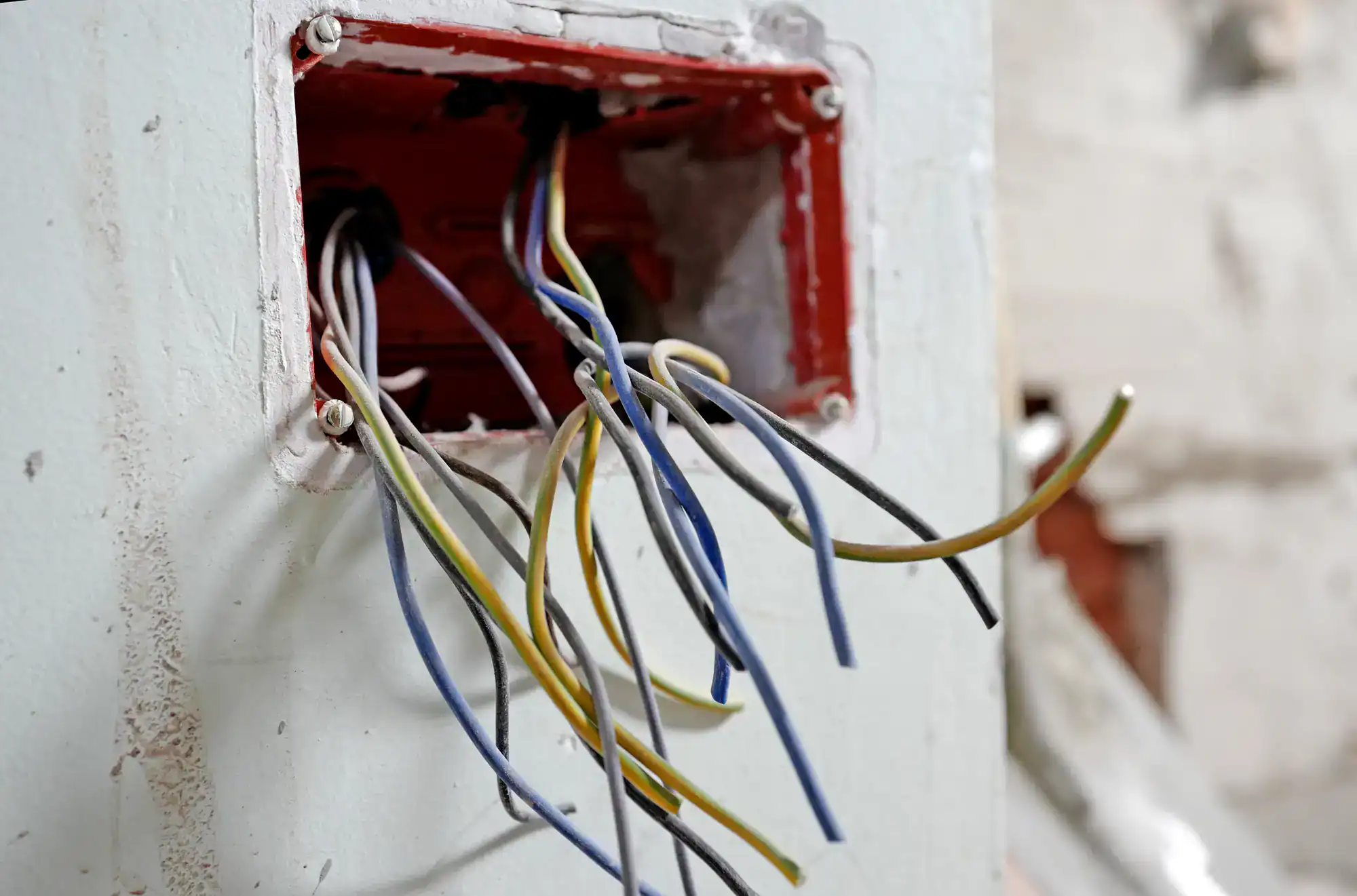
If a home inspector just handed you a report with “knob and tube wiring” flagged in red, you’re probably somewhere between confused and concerned right now. Maybe your insurance company brought it up. Maybe you’ve owned your home for years and someone finally mentioned it.
Either way, you’re looking for a straight answer — not a sales pitch, and not a panic-inducing worst-case scenario. So here it is: knob and tube wiring isn’t automatically dangerous. But under the conditions that exist in most older Providence County homes today, it very often is. Here’s what you actually need to know.
Knob and tube wiring was the standard electrical method used in American homes from roughly the 1880s through the 1940s. It gets its name from the two physical components that made it work: ceramic knobs that held the wires in place along joists and studs, and ceramic tubes that protected the wire where it passed through wood framing.
The system used two conductors — a hot wire and a neutral wire — run separately through the structure of the house, with an air gap between them acting as the primary safety buffer. There was no ground wire. At the time, that was fine. Homes had a handful of lights and maybe an iron. The wiring was designed to carry around 10 amps, and that’s roughly all it was ever asked to do.

Here’s where the honest answer gets more complicated. Knob and tube wiring that has been left completely undisturbed — no modifications, no insulation contact, no heavy modern loads — can still carry current within its original design limits. The system isn’t inherently dangerous just because it’s old.
The problem is that almost none of those conditions exist in a real home anymore.
Modern circuits carry between 20 and 30 amps. The original wiring was designed for 10. That gap matters — it means the system is routinely pushed two to three times beyond what it was built to handle. Over time, that kind of load causes the insulation coating the wires to degrade. The original covering was rubberized cloth or cotton, not the durable plastic used today. After 80 or 100 years, that material becomes brittle, cracks, and in some cases simply falls away — leaving live conductors exposed inside your walls.
Then there’s the insulation problem. A lot of older New England homes have had blown-in or spray foam insulation added to the attic over the years — it’s a sensible energy upgrade, especially given that Rhode Island has some of the highest electricity rates in the country. But when insulation surrounds knob and tube wiring, it traps the heat the system was designed to dissipate into open air. That’s not a theoretical risk. The National Electrical Code explicitly prohibits knob and tube wiring in spaces where loose, rolled, or foam insulation is present. If your attic has been insulated and your wiring hasn’t been replaced, you likely have a code violation — and a genuine fire hazard — whether anything has gone wrong yet or not.
The third issue is modification. Homes with knob and tube systems have almost always been worked on over the decades — by previous owners, handymen, or well-meaning contractors who spliced in modern Romex using basic wire nuts and called it done. Those connections are often improperly made and unprotected. A wire nut in a wall cavity isn’t a junction box. It’s an exposed splice that can arc.
Insurance companies have been paying close attention to knob and tube electrical systems for years, and their position has hardened considerably. Many insurers now refuse to write new policies on homes with active knob and tube wiring. Others will issue a policy but require a signed statement that the wiring will be replaced — typically within 60 days. Some will cover the home but at a significantly higher premium, and only after a licensed electrician has inspected and documented the system.
This is the moment most Providence County homeowners actually discover they have a problem. Not a fire, not a tripped breaker — a phone call from an insurance company at renewal time, or a line item on a home inspection report at the closing table.
Providence is one of the most affected markets in the country for this. The median construction year for homes in the city is 1938. Roughly 54.5% of Providence homes were built before the 1940s — which means more than half the housing stock in the city was wired during the knob and tube era. That’s not a niche problem. It’s the default condition of a Providence home.
The same is true across much of Providence County, from the mill neighborhoods of Pawtucket and Central Falls to the older residential streets of North Providence, Johnston, and Woonsocket. Rhode Island has the second-oldest housing stock in the country. That’s a point of character and history, but it also means the electrical systems in a lot of these homes were never designed for the way people live today. If your insurer is raising this issue, they’re not being unreasonable — they’re responding to a real actuarial risk that’s well documented in this market specifically.
Want live answers?
Connect with a Lightning Electric expert for fast, friendly support.
The question we hear most often after “is this dangerous?” is “what does replacing it actually involve?” And the honest answer is: it depends heavily on who’s doing it and how.
The standard approach — open up walls, fish new wire, patch the drywall — is disruptive and expensive. But it’s not the only approach, and in Providence County’s older housing stock, it’s often the wrong one.

A lot of the homes we work in across Providence County have horsehair plaster walls — the original plaster applied over wood lath that was standard construction before drywall existed. It’s durable, it has character, and it’s irreplaceable. Once you crack it open, you’re not patching it back to what it was. You’re living with a repair that never quite matches.
That’s why we use a camera-based approach that no other electrician in the area offers. We insert cameras through your existing outlets to locate the wiring and map its path inside the walls before we touch anything. That lets us remove the old knob and tube wiring and run new circuits with minimal wall penetration — often without opening the walls at all beyond the outlet boxes.
For homeowners in Federal Hill, the East Side, College Hill, Armory, and the older neighborhoods of Pawtucket and North Providence, this is the difference between a rewire and a renovation. Your plaster stays intact. Your walls look the same when we leave as they did when we arrived. The wiring is new, properly grounded, up to code, and documented for your insurer.
Every job we do includes pulling the required permits and passing inspection. That’s not optional — it’s how you protect yourself at resale and how you get the documentation your insurance company actually needs. We’re fully licensed Master Electricians, Electrical Inspector Certified, and members of the IAEI Roger Williams Chapter here in Rhode Island. When we sign off on a job, it means something.
We also offer financing through Synchrony Bank for homeowners who need to address this now but weren’t planning for it in their budget. An insurance deadline doesn’t wait for the right financial moment, and we’d rather help you find a way to get it done safely than have you defer it.
This is a fair question, and the answer isn’t always obvious. Some homes have had their knob and tube systems fully replaced. Others have had portions replaced while other runs remain active — often in parts of the house that weren’t touched during previous renovations. And some homes have wiring that looks like it’s been replaced but is actually just spliced into an older system.
The most reliable way to know is to have a licensed electrician assess it. A visual inspection of the panel, attic, basement, and accessible wall cavities can usually tell a knowledgeable electrician a great deal. If you’ve had a home inspection, the report will often flag visible knob and tube components — but a home inspector’s job is to note what they see, not to assess what’s active, what’s been modified, and what the full scope of the system looks like.
Some signs that your home may still have active knob and tube circuits: outlets throughout the house are two-prong (ungrounded); your breaker panel is older and hasn’t been upgraded; you’ve had flickering lights or frequently tripped breakers; or your home was built before 1950 and you have no documentation of a rewire. In Providence County, if your home was built before World War II and you’ve never had a licensed electrician assess the wiring, there’s a reasonable chance some portion of the original system is still in use.
The other scenario we see regularly is homes where the knob and tube wiring was partially replaced at some point — often the visible runs in the basement or attic — but the wiring inside the walls was left alone. That in-wall wiring is often the oldest, most degraded portion of the system, and it’s the hardest to assess without the right tools. If you’re not sure what you have, an inspection is the right first step. We provide clear, upfront assessments before any work begins — no hidden fees, no pressure, no surprise scope creep.
If you’ve just found out your home has knob and tube wiring, the most important thing you can do right now is get accurate information. The reality is somewhere in the middle of worst-case and dismissive, and it depends on the specific condition of your system, how it’s been modified over the years, and whether insulation has been added around it.
What we know for certain: Providence County has some of the oldest housing stock in the country, and a significant portion of it was built during the knob and tube era. This is a local issue as much as it’s a technical one, and it needs someone who actually knows these homes.
If you’re ready to get a clear picture of what you’re dealing with, Lightning Electric is here to help. We’ve been working in Rhode Island’s older homes for over 30 years, and we’ll give you a straight answer about what you have, what it means, and what it’ll take to fix it.
Summary:

Article details:
Share: