
For over 30 years, we’ve powered Rhode Island with expert electrical services delivered with a personal touch. Discover our story and commitment to quality.
Contact Info
Most Providence County homeowners with knob and tube wiring think they're okay. Most of them are wrong. Here's what's actually going on.
Rhode Island has some of the oldest housing stock in the country. If your home was built before 1950 — and in Providence County, a lot of them were — there’s a real chance it still has knob and tube wiring running through the walls. Most homeowners who know about it have heard something: it’s old, it might be a problem, maybe they’ll deal with it someday.
The trouble is that “someday” thinking is built on a handful of misconceptions that feel reasonable but aren’t. Some of them are costing people their insurance coverage right now. Others are creating fire risks that no one can see. Here are the seven things we hear most often — and what’s actually true.
Knob and tube wiring was the standard method of electrical installation from roughly the 1880s through the 1940s. It gets its name from the ceramic knobs that anchor the wires to structural framing and the ceramic tubes that protect wires where they pass through wood. At the time, it was a legitimate, code-compliant system — and it was installed in hundreds of thousands of homes across New England.
The reason it’s still so prevalent in Providence County specifically comes down to history. The mill towns that built this region — Providence, Pawtucket, Woonsocket, Cranston — were densely developed during exactly this era. The triple-deckers in Pawtucket, the Victorian-era homes in Federal Hill and Fox Point, the worker cottages throughout the inner-ring suburbs — most of them were wired this way when they were built, and a lot of that original wiring is still in place.
Here’s the misconception we run into constantly: homeowners assume that if the original wiring has been there for 80 years without incident, it must be holding up fine. That logic sounds reasonable. It isn’t.
The insulation wrapped around knob and tube wiring was never designed to last a century. It’s made from varnish and fiber materials that stretch, sag, and crack over time. When insulation breaks down, bare wire is exposed inside your walls — and bare wire near wood framing is exactly the kind of thing that causes house fires. The risk isn’t static. It compounds every year the system ages.
But here’s what matters even more than the age of the original wiring: what’s been done to it since. Knob and tube systems were designed to handle a 10-amp load across a maximum of about 12 circuits. A modern home runs dozens of circuits and draws far more current than that. When original circuits got overtaxed over the decades, some homeowners — or handymen, or unlicensed workers — “solved” the problem by splicing modern wire onto old K&T runs, or by swapping out 15-amp fuses for 25- or 30-amp ones to stop the breakers from tripping.
That second fix is particularly dangerous. A 15-amp fuse blows because the wire can’t safely carry more than 15 amps. Replacing it with a 30-amp fuse doesn’t solve the overload — it just removes the warning system. Now 30 amps of current flows through wiring rated for 15, generating heat inside your walls every time a heavy appliance runs. That heat has nowhere to go and nothing to stop it.
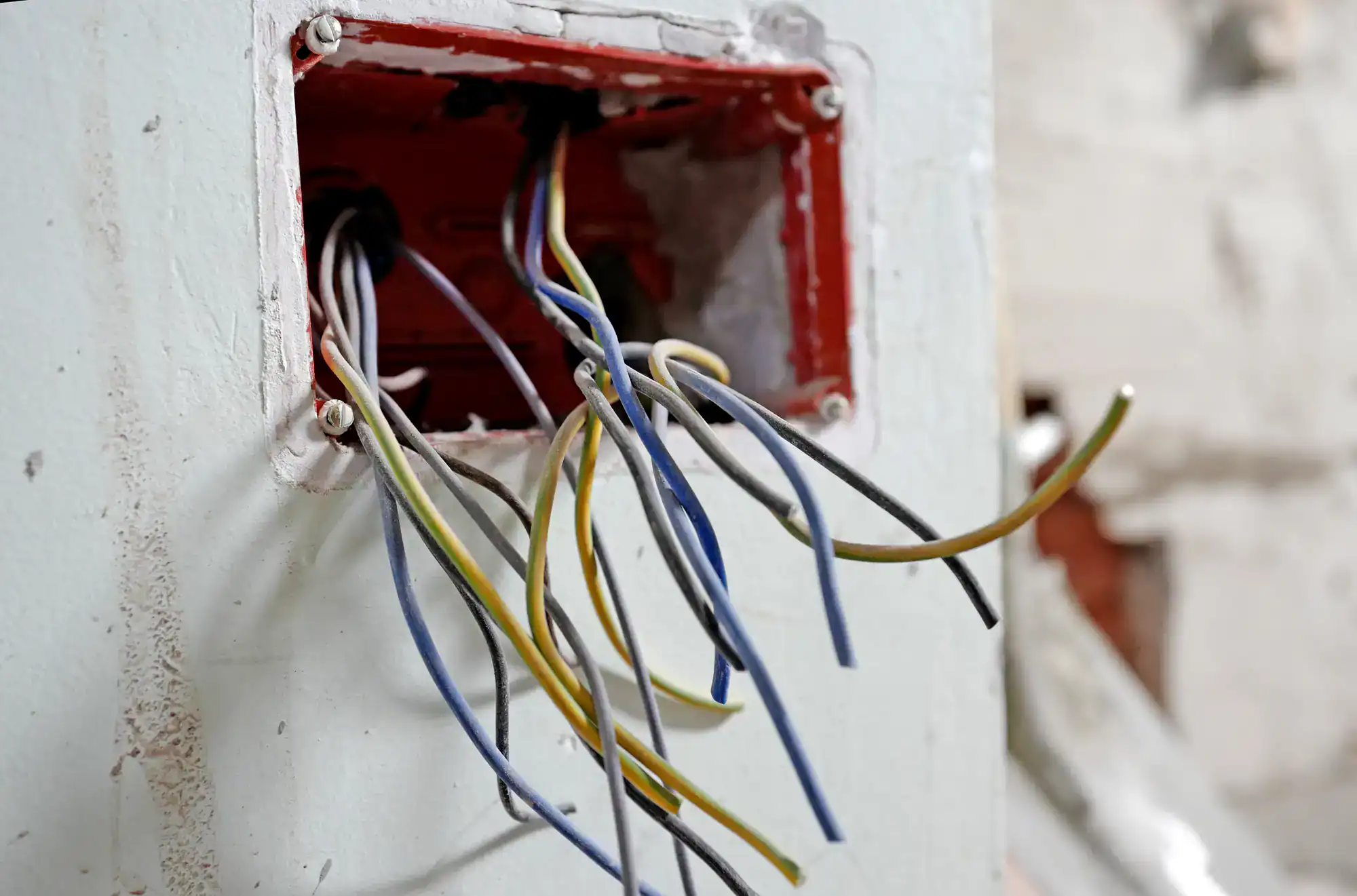
The splicing issue is just as serious. Because knob and tube wiring is accessible in older homes, it’s been modified by a lot of people who weren’t qualified to do it. Improper splices — sometimes wrapped with masking tape or electrical tape instead of proper connectors — create hazardous connections that don’t show up until something fails. The age of the original wiring is almost secondary to what’s been added to it over the years.
Rhode Island has been pushing energy efficiency hard, and a lot of homeowners have taken advantage of insulation rebate programs to add blown-in insulation to their attics and walls. It’s a smart move for energy costs. But if your home still has active knob and tube wiring, it can also be a serious fire hazard.
Knob and tube wiring was designed to dissipate heat into open air. The ceramic knobs hold the wires away from framing specifically to allow airflow around them. When you encapsulate those wires in blown-in insulation, you trap the heat they generate. There’s no longer any place for it to go. Over time, that trapped heat can degrade the insulation further and, in a worst-case scenario, ignite the surrounding material.
This is a situation where two individually reasonable decisions — upgrade your insulation, keep the old wiring — combine into something genuinely dangerous. It’s also not something a visual inspection from outside the wall can catch. If you’ve had insulation added in the last several years and you’re not sure whether your K&T wiring was addressed first, that’s worth a professional assessment. The homes in College Hill, Smith Hill, and the West End of Providence that went through energy efficiency upgrades in older building stock are exactly where we see this issue come up.
The broader point is that knob and tube wiring’s risks don’t exist in isolation. They interact with everything else happening in the home — insulation upgrades, added circuits, aging fuse boxes, and decades of modifications by previous owners. That’s why a blanket statement like “the wiring is old but it’s been fine” misses the picture entirely.
Want live answers?
Connect with a Lightning Electric expert for fast, friendly support.
Cost is the question that stops most homeowners from acting, and it’s also the question that gets the most vague, unhelpful answers online. The honest answer is that knob and tube wiring replacement costs vary — significantly — based on the specifics of your home.
The factors that move the number most are the size of the house, how much of the wiring needs to be replaced, how accessible the wiring is, how many new outlets and switches need to be added, and whether the electrical panel also needs to be upgraded at the same time. A small Cape in Johnston looks very different from a three-story triple-decker in Pawtucket. Every project gets priced on its own terms, which is why we work on a per-job basis rather than quoting a flat rate that won’t reflect what your home actually needs.
This is the misconception that catches people most off guard, and it’s the one with the most immediate financial consequences. A lot of Providence County homeowners have updated parts of their electrical system over the years — maybe they replaced the panel, added circuits in the kitchen, or had some work done during a renovation. They figure that since most of the wiring is modern, they’re covered.
Insurance companies don’t see it that way. If there is any active knob and tube wiring in your home, most insurers in Rhode Island won’t cover you — period. It doesn’t matter if it’s one circuit in the attic or a handful of original runs in a finished basement. The presence of active K&T wiring is, for most carriers, a disqualifying condition.
This creates a situation that surprises a lot of homeowners: they get a letter at renewal, or a flag during a home sale, and suddenly they’re looking at a deadline. Some insurers will allow an exception if a licensed electrician inspects the system and certifies it as safe — but that exception is narrowing as underwriting standards tighten. And it’s not a permanent fix; it’s a window.
The real estate angle is worth flagging here too. If you’re selling a home in Providence County — or buying one — a home inspection that turns up active knob and tube wiring is going to affect the transaction. Buyers want professional remediation documented, not a handyman’s assessment or a partial fix. The neighborhoods where this comes up most in real estate transactions are exactly the ones with the oldest housing stock: Fox Point, Elmhurst, the East Side of Providence, older sections of Cranston and Johnston.
If you’re in the middle of a transaction or facing an insurance deadline, the timeline matters. Getting a licensed Master Electrician on-site quickly — one who pulls permits and passes inspections, not one who works around them — is what protects you when the deadline is real.
This is one of the most common DIY fixes we see in older Providence County homes, and it’s understandable — it looks like it should work. The logic goes: my outlets are two-prong because I don’t have a ground wire. If I replace them with three-prong outlets, I’ll have a ground. Problem solved.
Except it doesn’t work that way. Replacing a two-prong outlet with a three-prong outlet without an actual ground wire in the circuit doesn’t create a ground — it just creates a three-prong outlet that isn’t grounded. That third slot gives the appearance of protection without providing it. Plugging sensitive electronics into an ungrounded three-prong outlet doesn’t protect them from power surges the way a properly grounded outlet would.
There is a legitimate workaround: GFCI outlets can be installed on ungrounded circuits and labeled “No Equipment Ground” per code. GFCI protection guards against shock in a specific way that doesn’t require a ground wire, and it’s a code-compliant option in situations where full rewiring isn’t immediately possible. But GFCI outlets don’t resolve the fire risk from deteriorating insulation, don’t address the capacity limitations of an undersized system, and don’t satisfy insurance companies that require complete K&T removal. They’re a partial mitigation, not a solution.
The same logic applies to panel upgrades. Upgrading from a 100-amp to a 200-amp panel is a meaningful improvement — but it doesn’t replace the branch circuit wiring running through your walls. A new panel feeding old knob and tube circuits is still a home with knob and tube wiring. The two projects are related but separate, and doing one doesn’t eliminate the need for the other.
What makes this particularly relevant in Providence County is that a lot of the homes here have had multiple partial fixes over the decades — a panel upgrade here, some new circuits there, outlet replacements in the kitchen — which can give homeowners a false sense that the system has been addressed. A full assessment by a licensed electrician is the only way to know what’s actually active and what’s been properly replaced.
The short answer: sooner than feels urgent, and before something forces the issue. The homeowners who end up in the worst situations are the ones who knew about the wiring, figured it had been fine for years, and waited until an insurance letter or a failed home inspection made the decision for them.
If you’re in a pre-1950 home anywhere in Providence County — Providence, Pawtucket, Cranston, Johnston, North Providence, East Providence, or the surrounding towns — it’s worth knowing exactly what you have. Not an estimate, not a guess based on when the house was built. An actual assessment by a licensed Master Electrician who can tell you what’s active, what’s been modified, and what the real exposure is.
The work itself doesn’t have to mean tearing your house apart. We use camera-based techniques that allow us to remove and replace wiring with zero to minimal wall damage — which matters a great deal in older homes with horsehair plaster and period details that aren’t easy to restore. If you’ve been putting this off because you’re worried about the disruption, that’s a conversation worth having. We’ve been doing this work in Providence County for over 30 years, and we’re here when you’re ready to get a straight answer.
Summary:
Share: